Food cost per plate is what the ingredients on one serving cost you, at the amounts you actually use, after trimming and cooking loss. Divide it by the menu price and you get your food cost percentage. That’s the whole formula.
The work is in getting each number right, and then keeping it right when your supplier’s prices move. Here’s how to cost one dish properly, how to turn that cost into a menu price, and how to spot the dishes that are quietly costing you money.
What goes into the cost of a plate
Everything that leaves the kitchen on that plate, plus a few things that don’t:
- The main ingredients, by weight or count.
- Sauces, dressings and garnishes. A ramekin of aioli is an ingredient.
- Cooking fat, seasoning, and any bread or butter that comes with the dish.
- Sides, if the price includes them.
- Packaging, for takeout and delivery orders.
The trap is yield. You buy a pound of raw chicken, but after trimming and cooking you might serve around three-quarters of it. Cost the plate on the raw price and every plate looks cheaper than it really is.
How to calculate food cost per plate, step by step
- Write the recipe for one portion, by weight where you can. “A handful” can’t be costed.
- Find the purchase price on your most recent invoice, along with the pack size.
- Convert it to a cost per recipe unit, such as per ounce or per gram.
- Adjust for yield. Divide the unit cost by the usable share. If 75% of the chicken makes it to the plate, divide by 0.75.
- Multiply by the portion size for each ingredient.
- Add it all up, including a small allowance for oil and seasoning if you don’t weigh them.
Then weigh a few portions as they’re actually plated. The recipe card says 5 ounces; the cook on a busy Saturday may be serving 6. Keep those supplier invoices filed, too. This guide to small business record keeping and how to file it covers what to hold on to.
A worked example: chicken sandwich with fries
Here’s a made-up but realistic plate. The prices are only illustrations.
- Chicken breast: $3.60 a pound raw, which is $0.225 an ounce. With a 75% yield, usable chicken costs $0.30 an ounce, so a 5-ounce cooked portion costs $1.50.
- Brioche bun: $6.00 for 12, so $0.50.
- Cheese slice: $0.30.
- Lettuce, tomato and pickles: $0.35.
- House aioli, 1 ounce: $0.20. Cost it as its own small recipe first.
- Fries, 6 ounces: $1.20 a pound frozen, so $0.45.
- Oil and seasoning allowance: $0.15.
Total food cost per plate: $3.45.
On a $12.00 menu price, the food cost percentage is $3.45 divided by $12.00, or 28.75%. Call it 29%. The plate leaves $8.55, and that is gross profit on the food only. Labor, rent, utilities, card fees and everything else still come out of it.
How do you price a menu from food cost?
Pick a target food cost percentage, then divide the plate cost by it:
Menu price = plate cost divided by target food cost percentage
At a 30% target, the sandwich comes out at $3.45 divided by 0.30, or $11.50. At 28%, it’s about $12.32.
There’s no universal right target. It depends on your rent, your labor, your style of service and the profit you need, so work it out from your own budget, ideally with your accountant. Then sanity-check the result:
- Compare locally. If similar cafes nearby charge $10 for a sandwich, a $14 one needs a reason.
- Round sensibly. $11.50 or $12.00 reads better than $11.62.
- Look at the whole order. A low-margin coffee that brings people in can be fine if the pastry beside it earns more.
Many owners also watch prime cost: food cost plus labor cost, as a share of sales. It’s a handy single number to check each week, as long as the target is one you’ve set for your own business.
Food cost percentage or profit per plate?
A low percentage isn’t always the best dish. Compare three plates:
| Dish | Plate cost | Menu price | Food cost % | Profit per plate |
|---|---|---|---|---|
| Chicken sandwich | $3.45 | $12.00 | 29% | $8.55 |
| Soup and bread | $1.40 | $7.00 | 20% | $5.60 |
| Steak salad | $6.20 | $16.00 | 39% | $9.80 |
The steak salad has the worst percentage and the most dollars per plate. You bank dollars, not percentages, so look at both, and then at how many of each you sell.
That’s the idea behind menu engineering. Sort each dish by popularity and by profit per plate, and four groups appear:
- Popular and profitable: protect them and keep them easy to find on the menu.
- Popular but low profit: nudge the price up or trim the cost carefully.
- Profitable but rarely ordered: move them up the menu, rename them, or have staff suggest them.
- Neither: rework them or take them off.
Keep plate costs current
A costing done once goes stale fast. Butter goes up, a supplier changes pack sizes, a cook starts using a bigger ladle.
- Recost a dish whenever a main ingredient’s price moves noticeably.
- Review every recipe at least once a month.
- Keep a waste log of what was thrown out and why, and put a cost on it.
- Count stock regularly. If you used far more than your recipes say you should have, look for over-portioning, waste or missing stock. This simple stock count routine for a small shop or stockroom works just as well for a walk-in.
A restaurant and cafe manager with recipe costing can recost the menu when a price changes, but the habit matters more than the tool.
Spreadsheet, subscription or offline system?
A spreadsheet is fine for a short menu. It gets painful with unit conversions, sub-recipes like that aioli, and one price change that has to flow through twenty recipes. One broken lookup and a dish’s cost is wrong without any warning.
Subscription restaurant software often connects to your point-of-sale system, reads supplier invoices and shares data across sites. If you run several locations, that’s worth a lot. It also costs every month: at, say, $80 a month, that’s $960 a year, every year.
A ready-made offline system is a one-time price and runs on the office computer or a tablet without internet. It doesn’t connect to your register, so you type in the end-of-day totals yourself. Each device keeps its own copy, and you’re responsible for the backups.
Keeping it all in one place
To build all this in a spreadsheet, you’d need an ingredients tab with pack sizes, prices and yields, a unit conversion table, a tab per recipe full of lookups, sub-recipes that feed main recipes, a target price formula and a menu matrix fed by sales. It’s doable, and it tends to become the kind of file only its builder dares to edit.
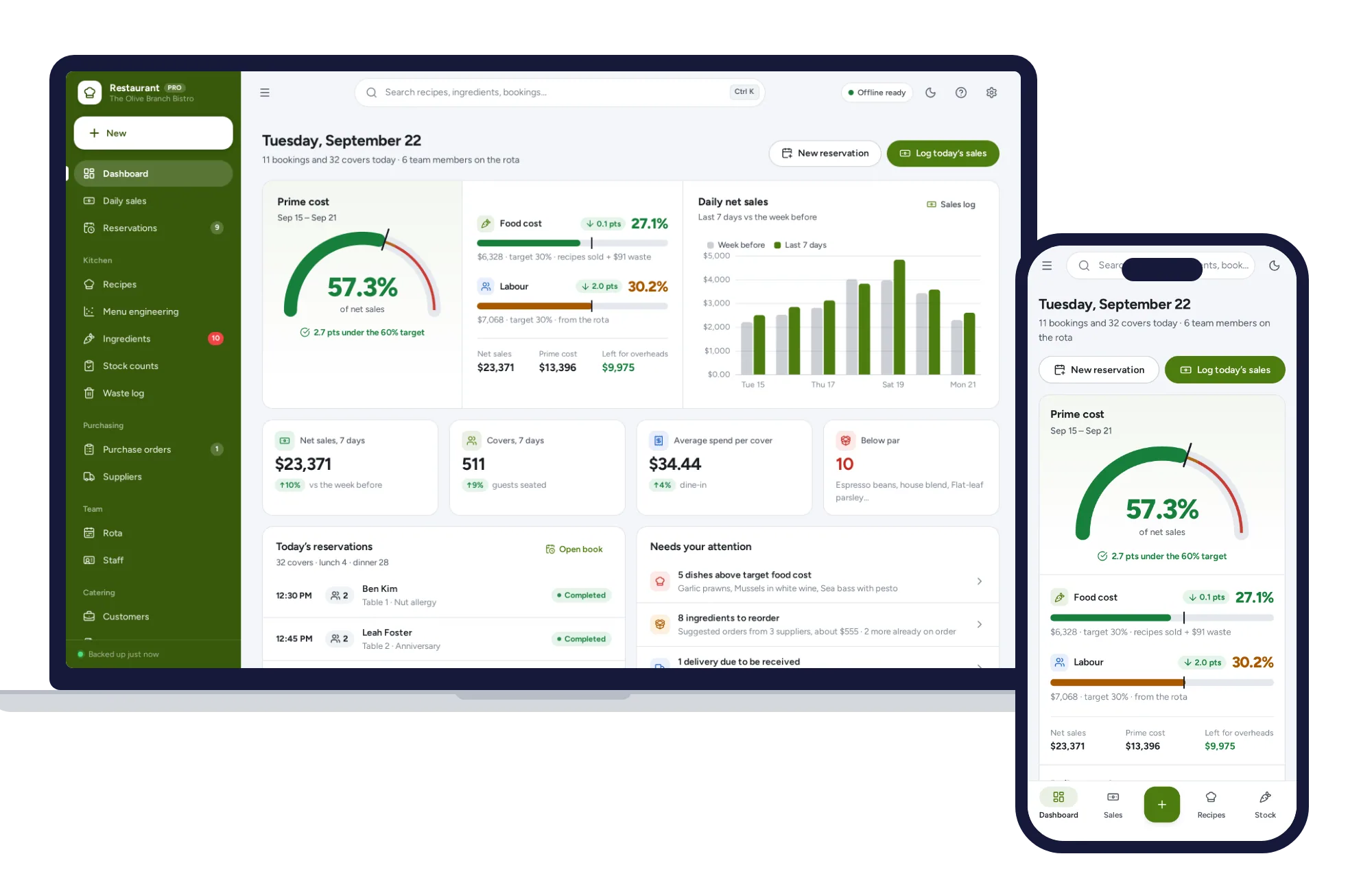
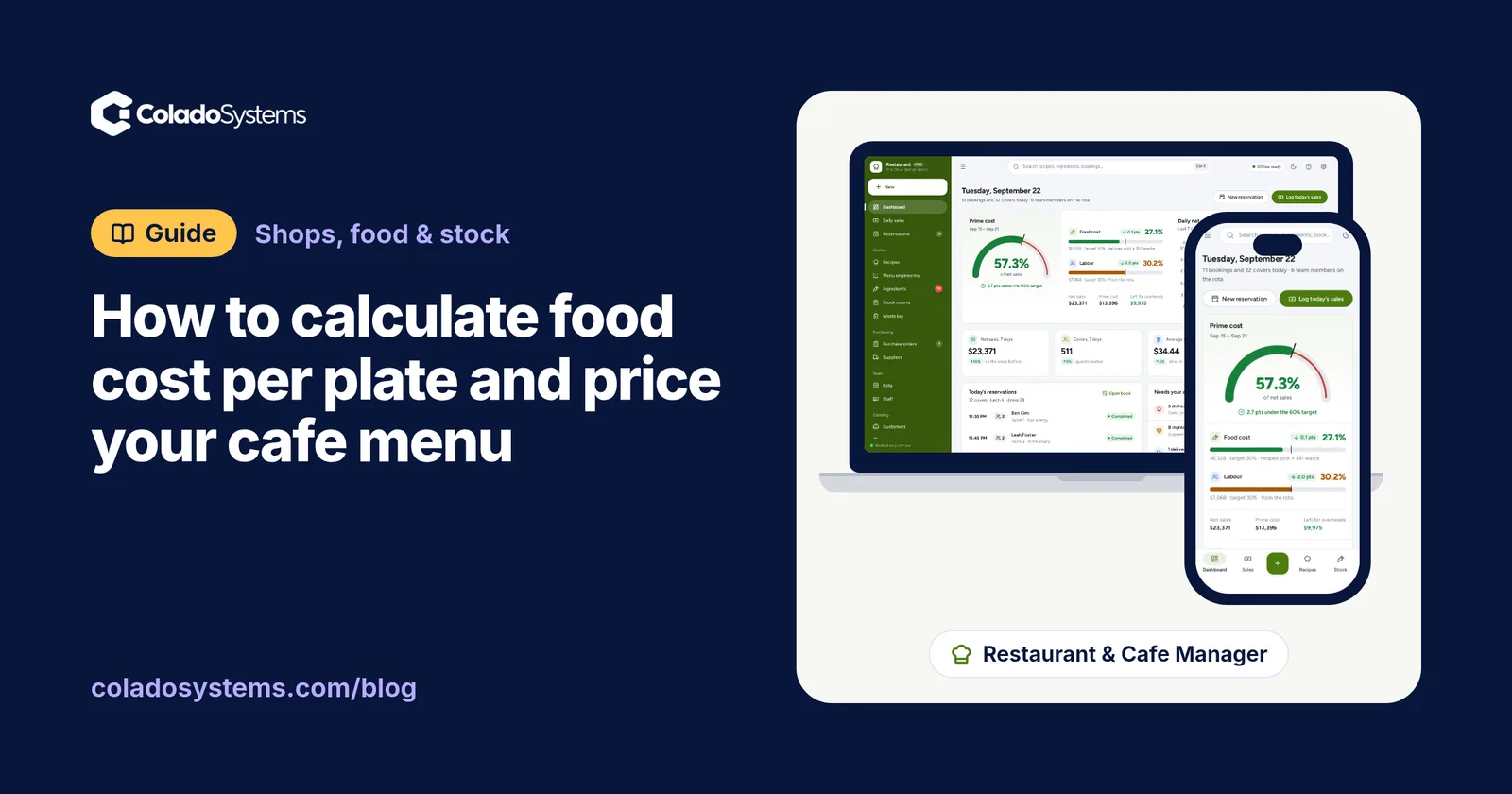
The Restaurant & Cafe Manager has it ready. The recipe costing studio works in any unit (grams, ounces, cups, each or packs), shows a food cost percentage gauge and the price that hits your target, and has allergens and sub-recipes built in. Ingredients keep pack sizes, yields and price history, and one price change recosts the whole menu, with a preview of the effect on each dish before you save. Menu engineering places every dish by popularity and margin, with a plain-language action for each group, over the last 30 days, 90 days or six months. The waste log is costed automatically, stock counts show variance in dollars, and the prime cost dashboard tracks food and labor against your target. There’s a staff rota, or shift schedule, with labor percentage per day, too.
You enter daily sales from the register’s end-of-day report, which takes about a minute. It opens with sample data so you can test it on a sample menu first, there’s no account or sign-up, it works offline, your numbers stay on your own device, and a PDF guide is included. If you sell retail as well, browse other systems for shops, food and stock.
You can see everything inside the Restaurant & Cafe Manager and try it with the sample data the same day.
Skip the setup
The Restaurant & Cafe Manager has the records this guide describes already set up. Recipe costing, menu engineering, inventory, ordering, rota and prime cost — one offline app.
$29.99 one-time
- Sample data to try it the same day
- Works offline, records stay on your device
- A PDF guide in the download
See everything inside the Restaurant & Cafe Manager. Or take the whole Shops, food & stock shelf: 7 systems for $114.99, $94 less than one by one.
Common questions
What is a good food cost percentage for a restaurant?
There is no target that suits every kitchen. The right figure depends on your prices, style of service, rent, labor costs and the profit you need to make. Work out a target from your own budget, ideally with an accountant, then track actual food cost against it each month and look into any dish or week that drifts well above it.
How do you calculate food cost percentage?
Divide the cost of the ingredients in a dish by its menu price and multiply by 100. A plate costing $2.40 that sells for $8.00 has a 30 percent food cost. For the whole kitchen over a month, add opening stock to purchases, subtract closing stock, and divide that figure by your food sales for the same month.
How do you price a menu item based on cost?
Divide the plate cost by your target food cost percentage written as a decimal. A dish costing $3.00 with a 30 percent target comes out at $10.00. Treat that as a starting point, then compare with similar places nearby, round to a price that reads well and check that the dish still leaves enough profit in dollars.
How often should you update recipe costs?
Recost a dish whenever the price of one of its main ingredients changes noticeably, when you switch supplier or pack size, and whenever the recipe or portion changes. On top of that, review every recipe on a regular schedule, such as once a month, so small creeping increases do not quietly eat into your margin.